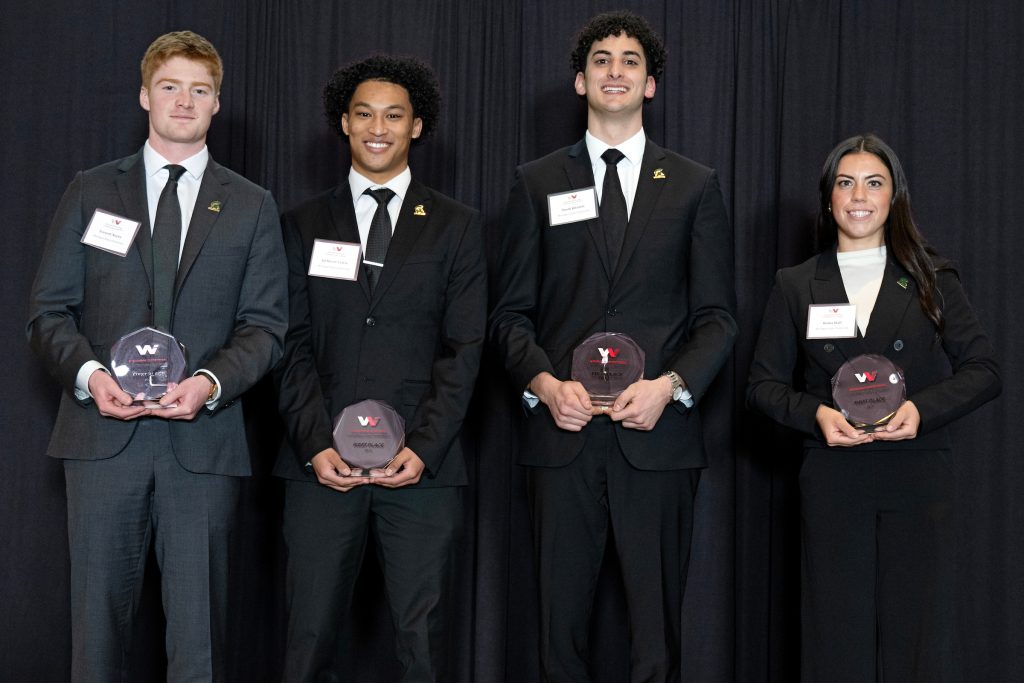
 The Michigan State University Team took first place in the Wisconsin Consulting Case Competition: (L to R) Everest Noyes, Jai Kozar-Lewis, Shadi Khamis and Raina Wall. Photo Credit: Paul L. Newby II / UW-Madison Wisconsin School of Business


A team of four Michigan State University Broad College of Business students earned first place at the 2026 Wisconsin Invitational Consulting Case Competition, outperforming 20 teams from universities across the country.
The Broad team, Raina Wall (senior, supply chain management), Shadi Khamis (junior, supply chain management), Jai Kozar-Lewis (senior, supply chain management) and Everest Noyes (senior, finance), stood out across both preliminary and final rounds, impressing judges from top consulting firms including McKinsey, Deloitte, Accenture, EY and KPMG. They were accompanied by Adam Merrill, senior associate director in the Russell Palmer Career Management Center.
slideshow has a previous and next buttons
The Michigan State University Team took first place in the Wisconsin Consulting Case Competition: (L to R) Everest Noyes, Jai Kozar-Lewis, Shadi Khamis and Raina Wall. Photo Credit: Paul L. Newby II / UW-Madison Wisconsin School of Business The annual competition brings together top undergraduate talent to solve real-world business challenges under tight timelines, testing both analytical thinking and team execution. This year’s field included teams from institutions such as Boston College, Case Western Reserve University, University of Michigan, University of North Carolina, Purdue University and the University of Texas at Austin.
Building a solution and a team
For Wall, the experience marked a full-circle moment.
“I’ve always been very intentional about putting myself around high-performing people, because I know that is what forces you to grow. But that was not always comfortable for me,” she said. “I still remember getting into Spectrum Consulting Group and Broad Student Senate as a freshman and sophomore and feeling like I had to prove I belonged there. This time, I was not walking into a high-talent room wondering if I belonged. I was walking in knowing I had earned the right to be there, and wanting to see what could happen when I was surrounded by people operating at that level.”
Photo Credit: Paul L. Newby II / UW-Madison Wisconsin School of Business
Preparation for the competition reflected a hands-on, relationship-driven approach. Rather than relying solely on secondary research, the team interviewed multiple industry professionals, including the CEO of the case client, to shape their recommendations.
“A lot of teams build from research. We built from people,” Wall said. “That allowed us to understand the problem from multiple angles and turn conversations into insight.”
Khamis emphasized the team’s disciplined and iterative preparation process.
“We prepared through consistent daily meetings for a full week, where we built, refined, and challenged our ideas,” he said. “Most importantly, we prioritized alignment. While each team member owned a specific part of the solution, we made sure everything connected back to the bigger picture. The strongest presentations come from that level of interconnection, where the team not only presents their piece but fully understands and can diagnose the problem as a whole.”
More than a win
As the competition intensified, the team leaned on leadership, clarity and resilience.
“The biggest skill was leading through uncertainty without letting the team feel it,” Wall said. “There is a huge difference between a team being tired and a team starting to break. On the day everything was due, we were exhausted. We had already put in so much work, and we still stayed together for three more hours polishing before submitting. That was one of the biggest moments of the whole experience for me.”
Khamis added that a hypothesis-driven approach helped him stay focused.
“I constantly tested, challenged, and refined our thinking throughout the process,” he explained. “That continuous iteration is what allowed us to stay focused, adapt quickly, and ultimately land on a clear direction.”
slideshow has a previous and next buttons
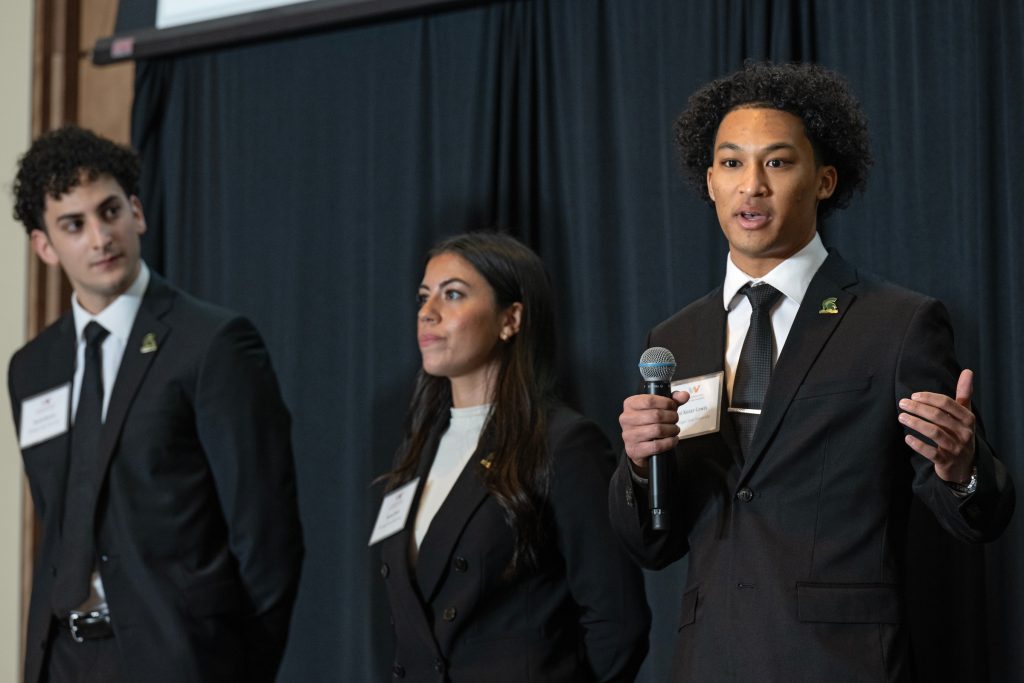 “The biggest skill was leading through uncertainty without letting the team feel it,” Wall (middle) said. “There is a huge difference between a team being tired and a team starting to break. On the day everything was due, we were exhausted. We had already put in so much work, and we still stayed together for three more hours polishing before submitting. That was one of the biggest moments of the whole experience for me.” Photo Credit: Paul L. Newby II / UW-Madison Wisconsin School of Business
 When the team was announced as the winner, the moment carried significance beyond the competition itself.
“That was such a real moment for me, because winning did not only feel like an achievement. It felt like a collision between where I started and where I was standing,” Wall recalled. “I did not come from a life where moments like that were expected. So, standing there, hearing we had won first place against schools that people naturally expect to dominate, it felt bigger than the competition itself. It felt like proof that your beginning does not decide your finish.”
For Khamis, the win also represented something larger for the college.
“Winning 1st place meant far more to me than the result itself. I was representing my entire university alongside students from 20 other schools,” he said. “This win reflects what Broad stands for. It reinforces our reputation and sets a higher standard for what excellence should look like moving forward and creates new opportunities for Spartans to secure jobs. To me, Broad Spartans should be recognized for consistently performing at that level, and this was a step toward building that identity.”
Why case competitions matter
Both students pointed to case competitions as a critical component of the Broad experience, one that bridges classroom learning and real-world application.
“Case competitions are pivotal for Broad Spartans because they offer an experience that closely mirrors an internship,” Khamis said. “You are working on a real-world problem that requires a real-world solution and delivers actual value. That level of application is something you simply do not get in a traditional classroom setting.”
slideshow has a previous and next buttons
 “Broad students know how to connect. We know how to ask good questions, build trust quickly, and turn conversations into insight. We treated that as a competitive advantage, because in business, it is one.” Photo Credit: Paul L. Newby II / UW-Madison Wisconsin School of Business)
 Wall added that these experiences highlight a defining characteristic of Broad students.
“Broad students know how to connect. We know how to ask good questions, build trust quickly, and turn conversations into insight. We treated that as a competitive advantage, because in business, it is one.”
While the first-place finish marked a major achievement, both Wall and Khamis pointed to the relationships built along the way as the most meaningful outcome.
“The part I will remember most was the car ride home,” Wall said. “That was when the competition stopped being about the case and started being about the people behind it. We spent hours talking about our families, our childhoods, and the deeper reasons each of us pushes as hard as we do. What stayed with me most was realizing that even though all of our stories were different, all four of us had something to prove.”
Khamis echoed that sentiment.
“Of course, winning was a major highlight, but what will stay with me most are the deep, meaningful conversations we had as a team during the drive to and from Wisconsin. Those moments built a level of connection that went beyond the competition itself. We came in with the goal of placing first, and we left with that achievement along with a strong bond with our entire team, which made the experience even more meaningful.”
Media Contact:
- Kelly Ulrich
- Communications Manager II
- ulrichk1@msu.edu
- (517)-353-7123
In Other News:

Each year, the college honors exceptional alumni and friends at the annual Celebrate Broad event
Get to know Ennalyse ahead of her taking the stage at Spring Convocation on May 1, 2026.

Samarth will take the stage on May 2nd as the Commencement Student Speaker
Get Connected with Broad:
- Business College Complex
- 632 Bogue St
- East Lansing, MI 48824