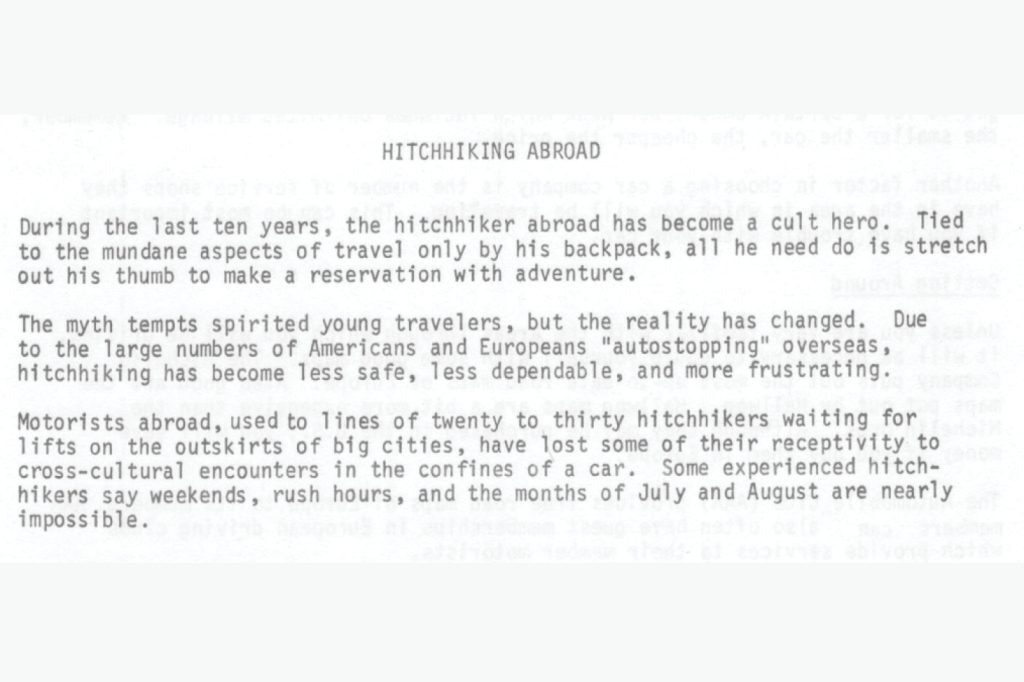
 “During the last ten years, the hitchhiker abroad has become a cult hero,” the guide noted, painting a picture of a backpacker who only “need do stretch out his thumb to make a reservation with adventure.” Reality, however, quickly set in as the guide wryly warned that overcrowding had made hitchhiking “less safe, less dependable, and more frustrating,” as European motorists grew weary of “lines of twenty to thirty hitchhikers” seeking rides.


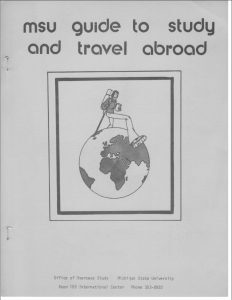
MSU’s Guide to Study and Travel Abroad was distributed to students in the 1980s to provide helpful tips and tricks for their adventures abroad.
In the early 1980s, Michigan State University’s Office of Overseas Study — the precursor to today’s Education Abroad office, distributed a Guide to Study and Travel Abroad that mixed practical tips with a tongue-in-cheek tone. Students preparing for international adventures were coached on everything from grabbing an International Student Identity Card (a must-have $6 card for student discounts abroad) to squeezing maximum value out of Eurail passes (a 14-day youth pass in 1981 was just $133!). The guide didn’t shy away from quirky advice: it even addressed the mythic allure of hitchhiking across Europe.
slideshow has a previous and next buttons
“During the last ten years, the hitchhiker abroad has become a cult hero,” the guide noted, painting a picture of a backpacker who only “need do stretch out his thumb to make a reservation with adventure.” Reality, however, quickly set in as the guide wryly warned that overcrowding had made hitchhiking “less safe, less dependable, and more frustrating,” as European motorists grew weary of “lines of twenty to thirty hitchhikers” seeking rides. Memories from Rotterdam
Broad alumnus, donor, recipient of the Broad Outstanding Alumni Achievement Award, and retired partner at Plante Moran, Jerry Jonckheere (B.A. Accounting ’81) had kept his copy of the guide after his semester abroad in Rotterdam and reflected on what struck him most about the experience. “The overseas study program in Rotterdam was my first large trip outside of the U.S. and I loved it” he said. “I was (and am) very interested in other cultures and people and it gave me a great chance to learn first hand about those cultures and interact with those from other countries. That love of travel and learning about other countries eventually led to my future in international tax. Even now that I’m retired, I schedule an international golf trip with international tax colleagues.”
Though the guidebook could have been discarded among the many souvenirs of student life, Jonckheere chose to preserve it alongside other momentos, all tucked into a memory box. “The easy answer is that I’m a bit of a pack rat (not a hoarder, but definitely a pack rat). I kept a memory box from my trip that included newspapers, drink coasters, beer menus, as well as class schedules and photos. The guidebook was one of the items in that memory box.”
For today’s Spartans considering their own leap abroad, Jonckheere stresses balance and connection.
“The advice that I would give is to understand the opportunity you have. You will need to balance class work (and the social aspects with other students) while taking in the foreign cultures. Take the time to interact with foreign students to learn about their view of the world and what plans they have for their life… and get email addresses to stay in touch. In the future, getting together in person when the opportunities arise are priceless.”
Fast-forward to today, the world has become the classroom for Broad Spartans, with over 260 study abroad programs in more than 60 countries now available through MSU. The college actively encourages every student to integrate a global experience into their education, emphasizing that stepping outside one’s comfort zone can profoundly influence career paths, boost self-confidence, and deepen cultural awareness.
A semester abroad, a lifetime of impact
Sarah Scott, the Walters Family Director of Education Abroad for the Broad College of Business, says the 40‑year‑old booklet does more than spark nostalgia – it validates the enduring impact of international experiences on students’ lives.
“Receiving this document from Jerry, a longtime supporter of education abroad in the Broad College, was confirmation of what so many of us working in international education know to be true: education abroad is a transformative experience, and one that stays with students long after they’ve returned home and completed their degrees,” Scott said. “Even scrolling through the digitized pages Jerry Jonckheere shared with me revealed the lighter, and sometimes downright quirky, side of study abroad in the early 1980s. It was also a real treat for me to peek behind the curtain and see how study abroad has evolved over time. I was especially shocked that students once paid extra for showers, and that the university offered such frank advice for students who were ‘broke as well as detained!’”
Experiential learning is the hallmark of Broad’s modern programs. Instead of roaming solo with a guidebook in hand, students join well-crafted experiences that blend academics with on-site industry exposure and cultural immersion. For example, an annual spring‑break supply chain management program takes students for an intensive week at the Panama Canal, a “critical supply chain artery,” where they tour facilities and meet logistics experts in an immersive, real‑world exploration of global commerce.
slideshow has a previous and next buttons
 The guide offered advice on everything from packing and transportation to budgeting and eating!
 Global citizens, global leaders
One thing that defines Broad’s education abroad program today is how it empowers students to step into entirely new ways of seeing the world, not just as tourists, but as active learners and global citizens. Through carefully structured pre-departure workshops, peer mentor pairings, and alumni networking events, each student arrives on site with both practical tools (from language basics to local customs) and a support system ready to guide them.
Broad’s faculty-led programs let students step into very different business landscapes while immersing themselves in local culture. In Cambodia, they visit two major cities, meet business leaders who apply their skills for the greater good, explore temples and palaces more than 900 years old, and experience first-hand innovative ideas and daily challenges in Cambodia. In Dubai, students join panel discussions with executives, visit thriving Emirati firms, and explore how culture shapes the fast-moving business environment of the UAE, learning about the broader challenges of operating in global markets.
When they return, students don’t just bring back polished résumés and slide decks; they come home with fresh perspectives on collaboration, adaptability, and intercultural communication, as well as concrete stories of how those insights have shaped their personal and career goals.
slideshow has a previous and next buttons
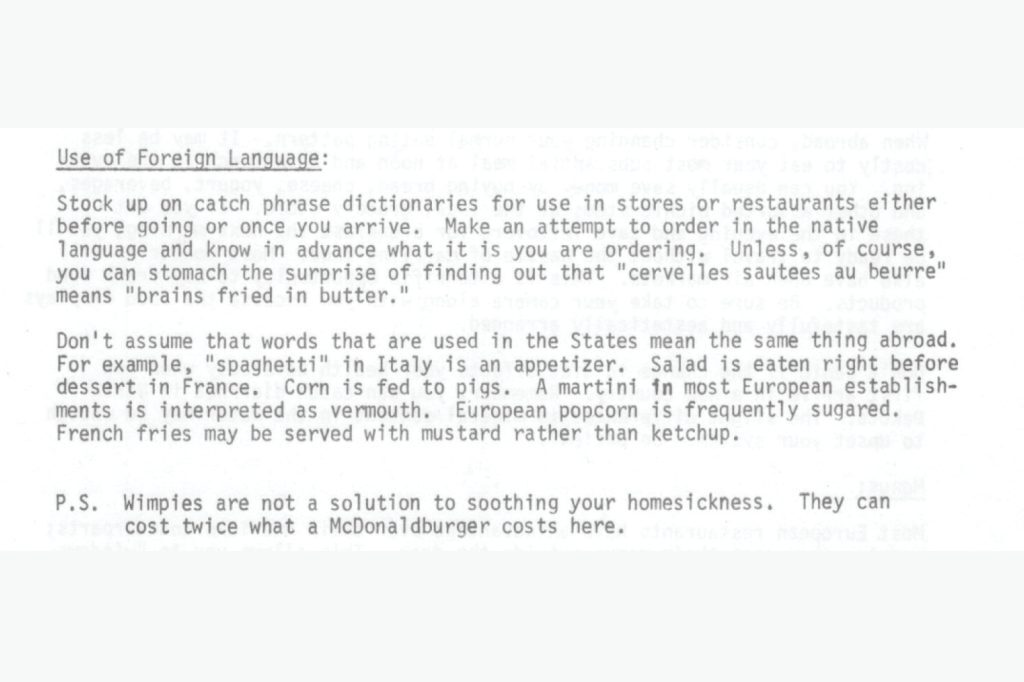 The guide also included advice on how to order at restaurants and the importance of learning food phrases before ordering. P.S. Wimpies is a popular fast food chain in the UK!
 Comparing the 1980s guidebook to today’s programs reveals striking differences in tone, tools, and preparation, even as the heart of study abroad remains the same. The old guide brimmed with travel hacks and cheeky commentary, preparing students to be lone explorers. Now, the messaging focuses on career readiness, cultural intelligence, and personal growth, aligning with Broad’s mission to produce global business leaders. Tools and logistics have leapt from analog to digital: where students once relied on traveler’s checks, paper rail timetables, and the occasional collect call home, they now carry smartphones with Google Maps, instant messaging, and 24/7 emergency contacts.
In both eras, whether hitchhiking across Europe with a paper map or collaborating on business cases across time zones, Broad Spartans have always shared a sense of adventure, curiosity, and global ambition. As the world changes, so too does the way we explore it, and Broad’s education abroad program continues to evolve with intention. What remains unchanged is the transformative power of stepping into the unknown and returning with not just memories, but a new mindset.
Learn more about education abroad programs and other global opportunities at Broad at the Education Abroad webpage.
Media Contact:
- Kelly Ulrich
- Communications Manager II
- ulrichk1@msu.edu
- (517)-353-7123
In Other News:
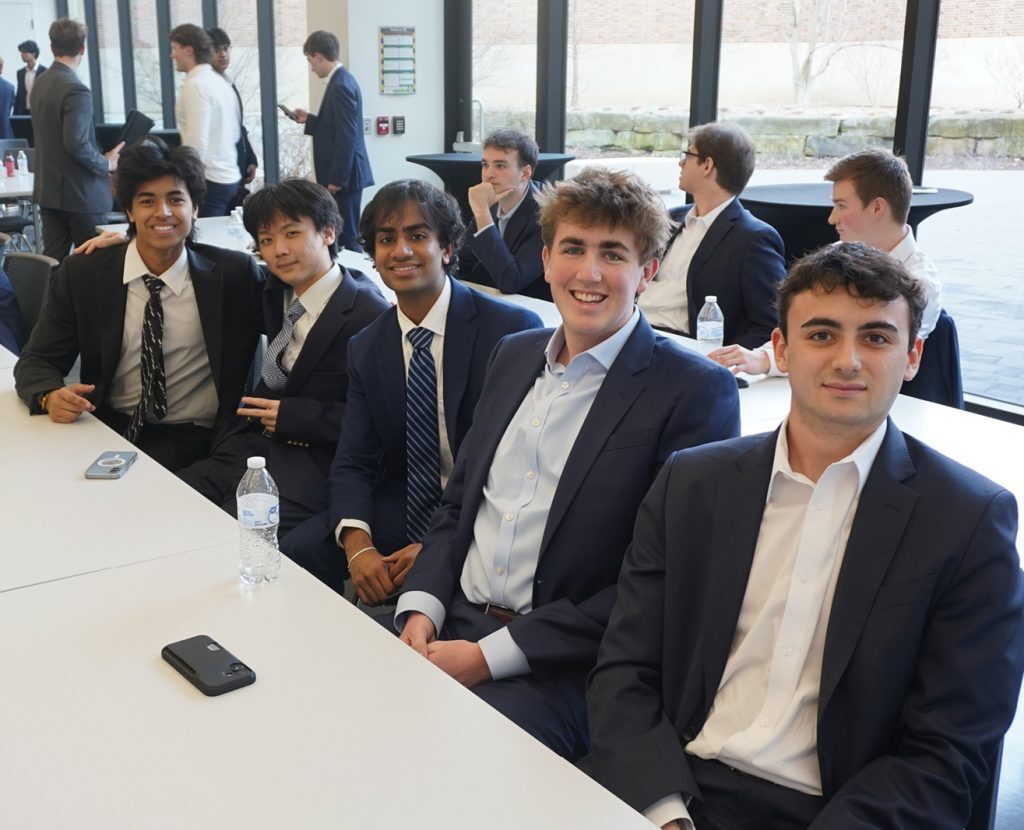
The Broad College of Business hosted the second annual Private Equity Case Competition on Apr. 3.

Enna Fretz is a senior majoring in marketing with a minor in entrepreneurship and innovation at Broad

Jacob Dunham is a senior majoring in supply chain management at the Broad College of Business.
Get Connected with Broad:
- Business College Complex
- 632 Bogue St
- East Lansing, MI 48824