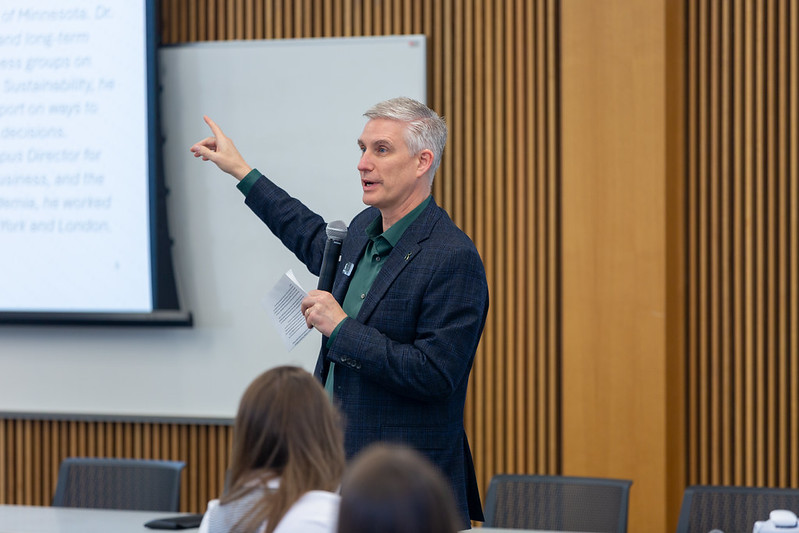


Food systems sit at the intersection of agriculture, logistics, technology, policy, and community—and addressing their failures requires more than isolated expertise. It requires the kind of deliberate, cross-sector collaboration that the Food Access & Supply Chain Technology Lab (FAST Lab) at Michigan State University’s Broad College of Business was built to foster.
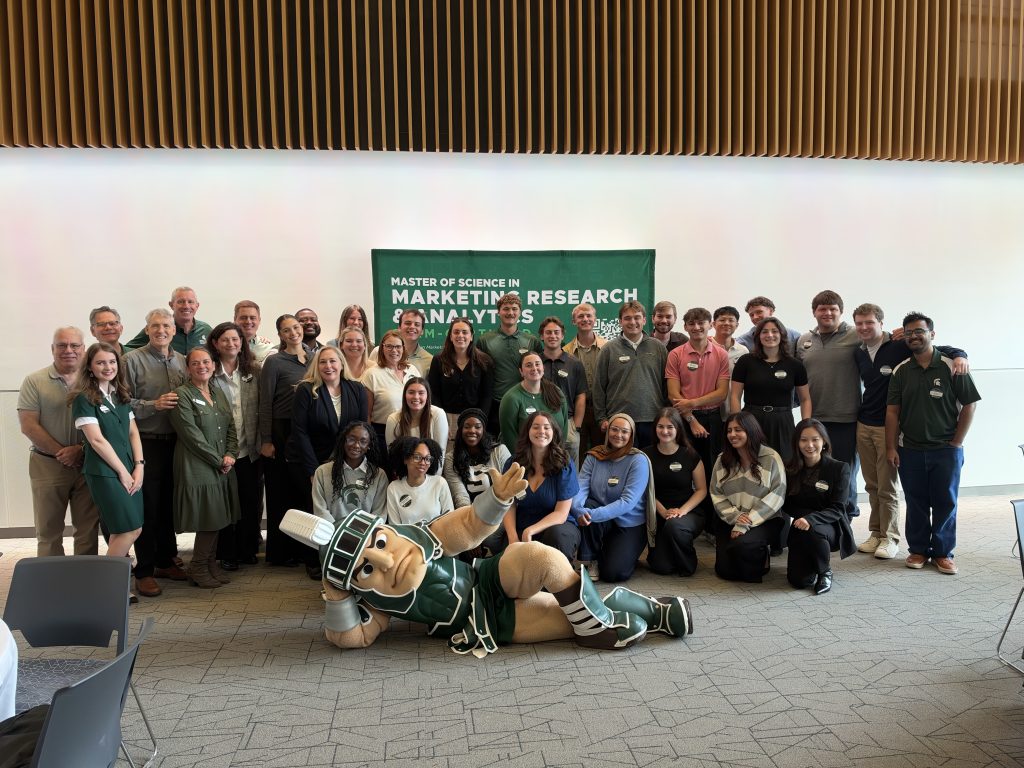
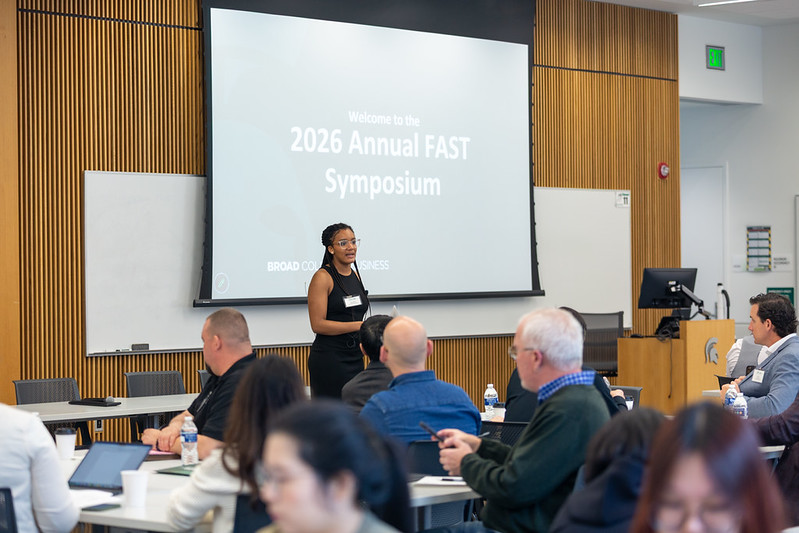
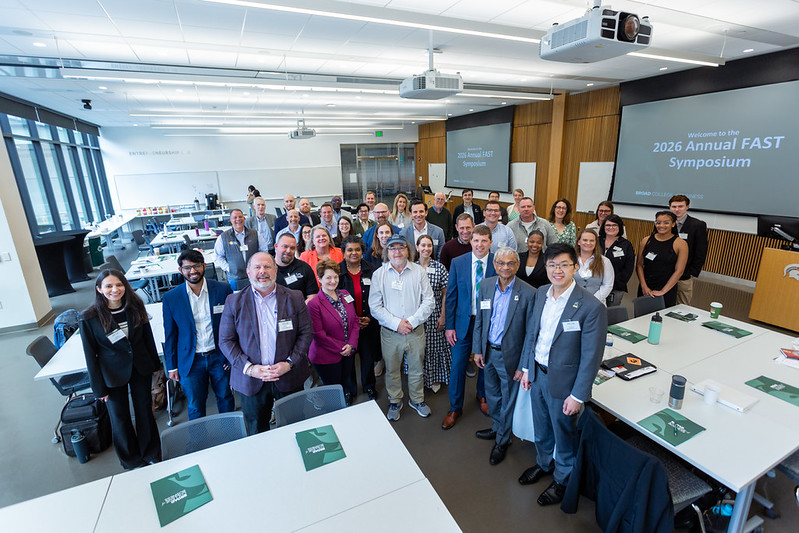
On Apr. 17, 2026, that mission came to life at the inaugural FAST Lab Symposium, a full-day convening of academics, industry leaders, nonprofit operators, government officials, and students united around a shared challenge: building food systems that are equitable, efficient, and resilient. This was a joint initiative between the School of Hospitality Business and the Department of Supply Chain Management in an effort to solve issues and challenges facing the US and global food system. This collaboration expands across the university, including faculty and community members from the School of Packaging and the Department of Agriculture, Food, and Resource Economics.
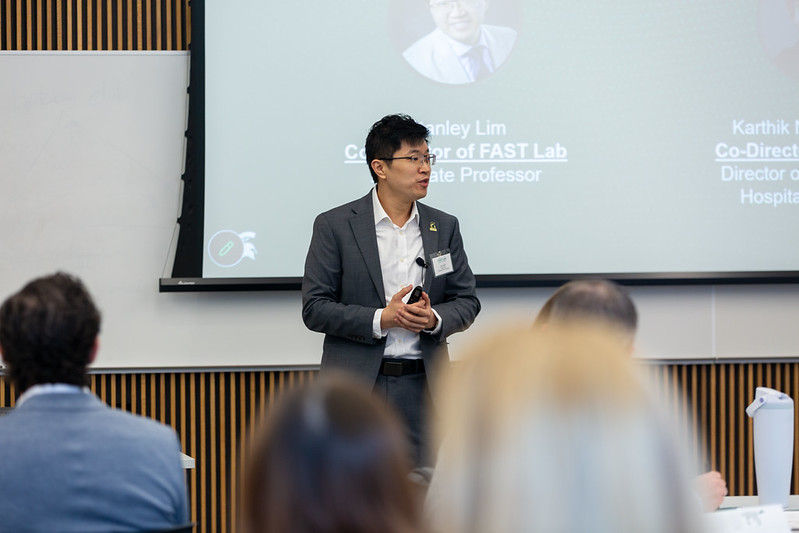
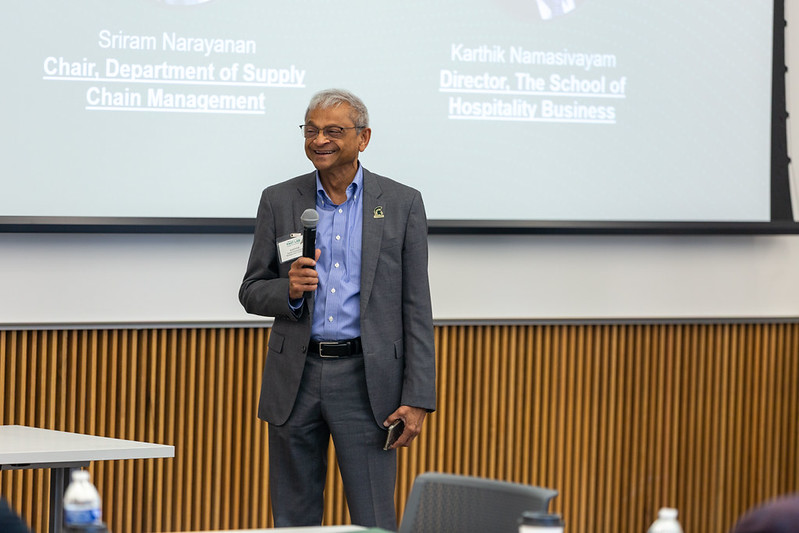
For the lab’s co-directors, the event represented something larger than a single gathering. “We recognize that sustainability is a big issue for us,” said Dr. Karthik Namasivayam, the Director of The School of Hospitality Business. “So we want to bring us all together so that the industry and the research [on] sustainability can work together.” That spirit carried through every panel and presentation across the day, and in his closing remarks, Stanley Lim, associate professor of supply chain management, offered both a summary and a charge: “Food systems are complex, but the solutions are reachable—especially when the right partners, the right data, and the right operational thinking come together.”
slideshow has a previous and next buttons
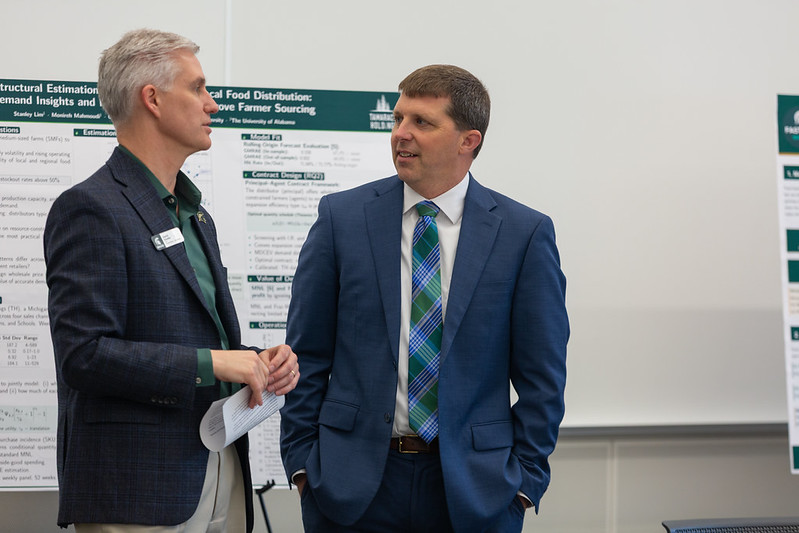
A symposium of this scale doesn’t come together on its own. Behind the panels, poster sessions featuring research conducted by students across campus, and brainstorming sessions was a dedicated conference team working collaboratively—many of them students gaining hands-on experience in the very fields the event was designed to explore. Kamaria Green, a professorial assistant to Lim, described the experience of wearing many hats: coordinating promotional materials and LinkedIn outreach, managing AV and merchandise logistics, supporting the event booklet with MSU’s Broad marketing and design department, and filling in wherever the team needed an extra hand. That flexibility, she noted, was baked into the team’s culture from the start. “We always fill in for somebody who isn’t able to complete something,” she said. “We’re all supporting each other because at the end of the day, you have to support each other if you want to get things done.”
Agriculture, policy, and the FAST Lab mission
Opening remarks from David Souder, the Eli and Edythe L. Broad Dean, and FAST Lab co-directors Stanley Lim, and Karthik Namasivayam, director of The School of Hospitality Business, framed the day’s ambition: translate discussion into coordinated action on food access, supply chain resilience, and waste reduction. Lim noted that MSU’s interdisciplinary position—spanning supply chain, hospitality, and agriculture—makes it uniquely suited to tackle these problems. “Our objective here is very simple, but ambitious: to move beyond this discussion towards a coordinated action that helps to improve food access, supply chain resiliency, and also reduce waste,” Lim said. “It’s truly our pleasure to be able to partner with organizations across ecosystems, including retailers, logistics providers, food rescue organizations, and technology firms to ensure that our work is grounded in real-world operational constraints and scalable in practice.”
Keynote speaker Tim Boring, director of the Michigan Department of Agriculture and Rural Development (MDARD), offered a vivid portrait of the state’s food systems landscape. “Michigan’s agricultural diversity is an asset”, he argued, but realizing its potential requires deliberate investment—more processing infrastructure, stronger regional market connections, and smarter policy. He highlighted MDARD’s regenerative agriculture initiative, the Farm-to-Family grant program, and a new Good Food for Michigan procurement project. He was transparent about headwinds: federal disinvestment in food and conservation programs, state budget pressures, and a growing tension between farmland preservation and renewable energy development. “If we’re going to have a greater path forward for Michigan communities, for farms growing things in a different way—this is a powerful way to do it,” he said.
Reducing food waste: Hospitality and retail operations
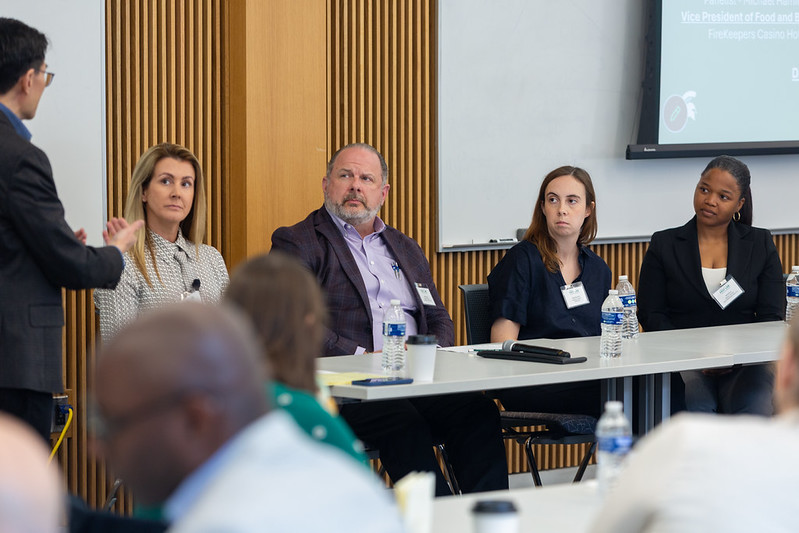
The first panel, moderated by Adrian Choo, associate professor of supply chain management, gathered practitioners from a casino hotel, a European river cruise line, a meal kit company, and a restaurant chain to discuss food waste prevention on the ground.
A consistent theme was the challenge of culture and training. Monica Johnso, Senior Director of Supply Chain at First Watch Restaurants, described teaching 15,000 employees across 650 locations not just what to do, but why every action, including but not limited to handing out extra napkins, has a cost. Michael Hamilton, Vice President of Food and Beverage at FireKeepers Casino Hotel, took a grassroots approach: a quality assurance chef reviews incoming deliveries each morning, holding vendors accountable for freshness and dates. He also uses sous vide cooking to cut protein shrinkage by up to 30 percent and channels short-dated products to a local community pantry.
Julie Higgins, Senior Director of Sustainability and Strategic Hotel Operations at Uniworld Boutique River Cruises, described a five-year journey from having no food waste measurement at all to achieving a 51.5 percent reduction per person per day—enabled by a Lean Path AI-powered tracking system and a disciplined approach to onboard production. The company’s next target is 75 percent, to be reached in part by eliminating buffets. Madeline Jerge, Director of Operations at HelloFresh, highlighted forecasting complexity—managing 100 rotating weekly recipes and up to 800 individual SKUs—and explained how a new customer personalization model has simultaneously improved satisfaction and reduced waste on the front end.
slideshow has a previous and next buttons
Research: Online grocery channels and inventory management
The first research presentation by Bengü Nur Özdemir, assistant professor of the University of Wisconsin-Whitewater, in a joint study with Lim examined what happens when grocery retailers partner with third-party delivery platforms like Instacart or DoorDash. Drawing on transaction data from a Midwest supermarket chain from June 2021 to March 2023, the study found that online channel adoption generates genuine new demand—about $28 in additional spending per customer—rather than simply shifting purchases away from physical stores. Any in-store cannibalization was small and faded within two weeks.
Because online and in-store orders share the same physical inventory, early surges in online demand can empty shelves for walk-in customers. The researchers proposed a lateral transshipment model—redirecting surplus stock from unaffected stores to those experiencing demand shock increases—finding it economically viable within a 200-kilometer radius. Audience discussion explored whether online ordering might also reduce household food waste by curbing impulse buying and enabling pickers to prioritize shorter-dated products.
Food Logistics: Fragility, Resilience, and Distribution Gaps
The food logistics panel, moderated by Judith Whipple, Bowersox-Thull Endowed Professor of Logistics, surfaced a shared diagnosis: demand volatility, climate disruption, and geopolitical instability have compounded into a system that is increasingly hard to plan around. John Herbert, Director of US Supply Chain at Gordon Food Service, noted that ensuring a product’s journey from farm to consumer requires many things to go right within very tight shelf-life windows. Mark Coe, general manager of Michigan Farm To Freezer, described moving his company from northern Michigan to a new Caledonia facility for better infrastructure, while also exploring a rural pilot processing program to re-serve smaller local growers.
Walmart’s supply chain representative, Sri Thirumalai, outlined current resilience investments: multi-sourcing to reduce supplier dependency, dynamic cold chain monitoring calibrated to ambient temperature and vehicle type, and smarter inventory segmentation for perishable goods. Dan Schoonmaker, executive director of Michigan Sustainable Business Forum offered a sobering systems view: Michigan landfills currently receive over two billion pounds of food annually—nearly 20 percent of total municipal solid waste—representing roughly one billion dollars in uncaptured economic value. He argued that sustainability and resilience are not in tension; organizations that authentically integrate sustainability are better positioned to weather disruptions.
Circularity: Food rescue, measurement, and the branding of waste
The afternoon circularity panel moderated by Steve Finn, the Vice President of Sustainability and Public Affairs at LeanPath, examined why food waste remains a stubborn problem despite growing awareness—and what is actually working. Brian Lipinski, manager of the World Resources Institute’s 10x20x30 Initiative, noted that while 73 percent of food businesses mention food waste in their external reporting, only 37 percent have made quantifiable reduction commitments. He also cited a 17% drop in Fortune 500 sustainability reporting in 2025, suggesting a broader retreat from public accountability.
Joe Robbins, chief product officer of Food Rescue US, emphasized the importance of data infrastructure for AI readiness and described a new tool, DonorLink, to integrate food recovery directly into business point-of-sale systems.
Jason Collis, chief operating officer at World Central Kitchen, reframed the issue from the perspective of crisis operations: in disaster zones, scarcity—not surplus—is the challenge, and solutions are almost always local. In Gaza, his team flash-froze produce stuck at the border to preserve it until it could be distributed. “The answers are in front of us,” he said. “We just have to make the hard decisions to look up and see them.”
Research: What motivates food rescue volunteers?
Chao Wu, Assistant Professor of Global Supply Chain Management at Wayne State University, in a joint work with Lim, presented findings from a 22-week randomized field experiment with 901 food rescue volunteers at Last Mile Food Rescue. Two behavioral interventions were tested: one emphasizing individual impact, one emphasizing collective group identity. The social framing—“we as food rescue heroes”—increased rescue frequency by 40 percent and participation rates by 20 percent. Individual framing worked better for volunteers from higher-income ZIP codes, consistent with social psychology research on identity and status. Wu also flagged volunteer attrition as steepest in early stages, making onboarding the highest-leverage intervention point.
Closing: Priorities, data, and next steps
Group voting at day’s end surfaced three priority research topics: reducing friction in food donor-nonprofit data reporting; understanding what messaging motivates food waste reduction; and assessing how shifts in federal food program funding affect community food security. Before closing, Michael Hamilton shared valuable data from the Calhoun County food bank director: charitable food demand is up 20 to 30 percent since COVID, federal protein supply has dropped sharply, and federally funded snack programs—which account for roughly 54 billion meals nationally, nine times what food banks provide—face significant cost-shifting to states by 2027 and 2028. Lim is committed to forming working groups around the top priorities and producing a synthesis working paper to circulate to participants over the summer. ‘The real measure of this symposium isn’t what we discussed today—it’s what we build together tomorrow,’ he said, ‘Our challenge now is to turn research into action, data into decisions, and partnerships into lasting improvements in food access and sustainability.’