skip to main content

2026 Ethics Weeks: Leading with Integrity

By Jadie Calice, student writer
Tuesday, February 24, 2026

What does it truly mean to lead with integrity? That question sat at the center of Michigan State University’s 2026 Ethics Week, challenging students to think about decision-making in business and entrepreneurship.  

Elizabeth Hammond is the managing director of the Center for Ethical and Socially Responsible Leadership within the Broad College of Business and one of the organizers behind the week’s programming. 

“The point of ethics is to elevate the conversations and understanding that all of us are making ethical decisions every single day, from both our personal standpoint, as well as our professional standpoint,” Hammond said. 

Ethics Week, now in its second year, brought together more than 30 events across campus, including 10 within the Broad College. The initiative is a collaboration between multiple ethics-focused groups at MSU, designed to expose students to a wide range of real-world ethical dilemmas across industries. 

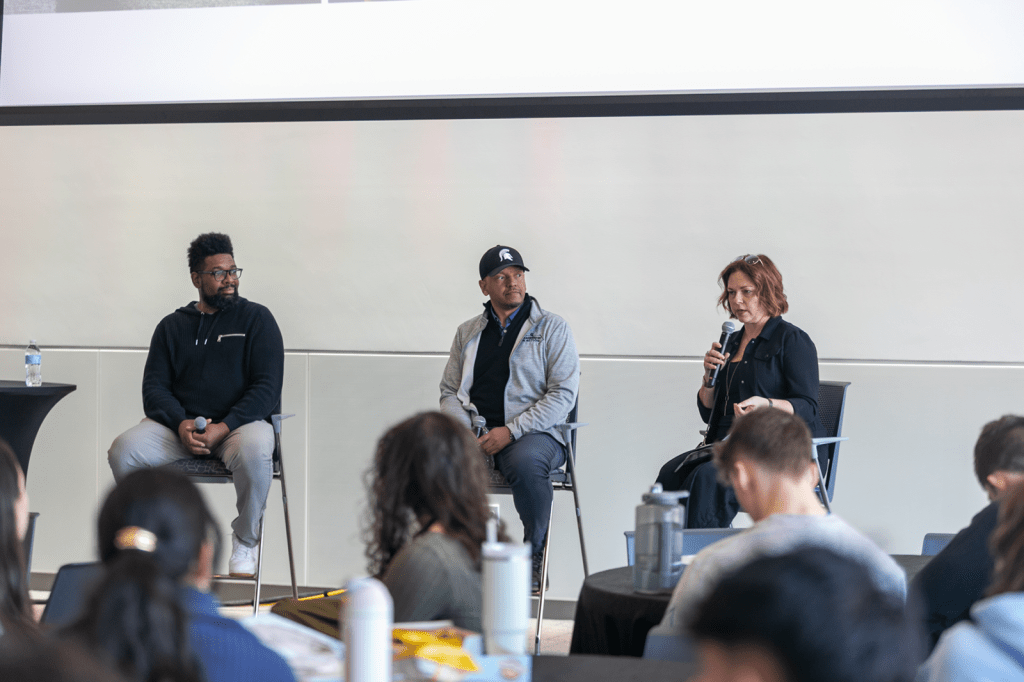
On Feb. 16, the Lunch & Learn: Made in Michigan, Built on Integrity was hosted in partnership with the Burgess Institute for Entrepreneurship & Innovation, the Russell Palmer Career Management Center, and the Center for Ethical and Socially Responsible Leadership. The session featured Chad Jordon, CEO of Cravings Gourmet Popcorn, and connected students with entrepreneurs, industry leaders, and innovators in an informal, conversational setting, exploring the intersection of ethics and entrepreneurship.

The Ethics of Complicity – The Economy of the Holocaust brought Harry Smith, senior education program manager from the Zekelman Holocaust Center, to campus for a discussion that challenged students to confront one of history’s most difficult truths. The conversation examined how companies participated in war crimes, discrimination and injustice, focusing on corporate complicity during the Holocaust and the economic decisions that helped enable the murder of more than six million Jewish people.

Smith’s presentation encouraged students to consider how ordinary businesses, operating within a functioning economic system, became instruments of genocide. He also emphasized the lasting consequences of those decisions, showing how their impact continues to affect individuals and communities today.

To underscore this point, Smith shared the story of a Holocaust survivor who still checks where her medication is manufactured before purchasing it, refusing to use products from companies linked to the production of gas used in concentration camps. The example illustrated that the consequences of corporate actions cannot be erased, even as organizations evolve.

For students, the discussion served as a powerful reminder that the decisions they make in their careers can carry lasting impact.

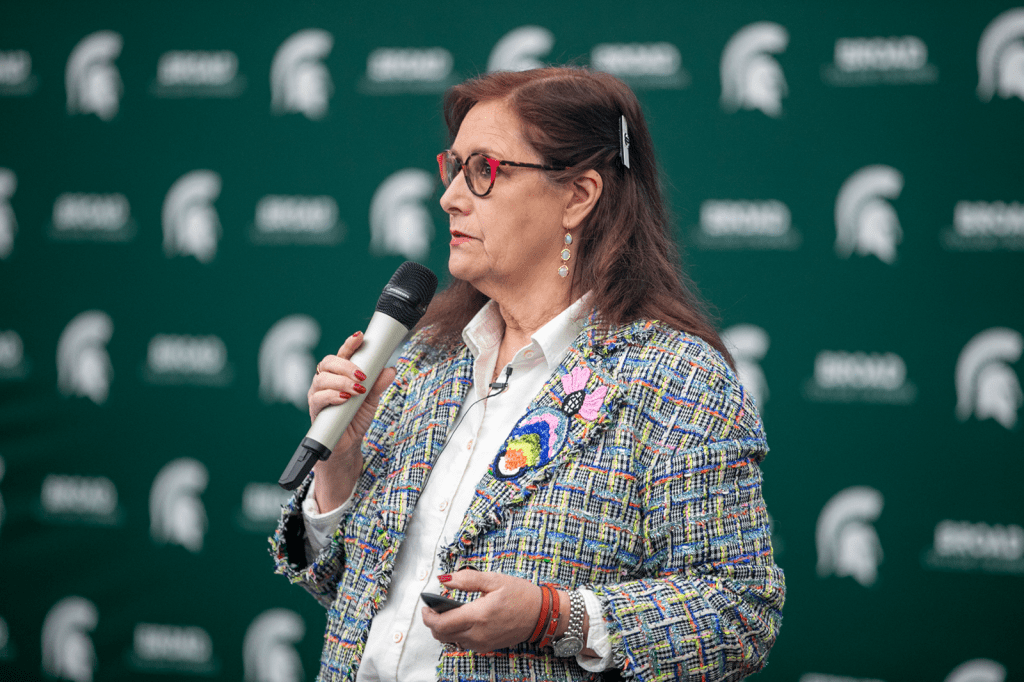
On Feb. 18, the Roy S. Pung Executive Speaker Lecture welcomed Kay Firth-Butterfield, a global leader in AI governance, to campus to address one of today’s most pressing ethical frontiers: artificial intelligence. Drawing on years of experience at the intersection of technology and policy, she emphasized that AI is not a distant or abstract issue. It is already reshaping how we work, connect and make decisions.

Her message challenged students and leaders alike to consider who innovation is truly serving and whether it is being developed and used responsibly.

“AI must remain in service to humanity, not the other way around,” said Firth-Butterfield.

To underscore the urgency, she cited Pew Research data showing that 50% of Americans feel more concerned than excited about AI in 2025, and 60% want greater control over how it is used in their daily lives.

Firth-Butterfield emphasized that leaders must look beyond efficiency and consider trust, customer acceptance, the impact of job loss on purchasing power, environmental consequences and long-term resilience. She encouraged organizations to implement safeguards, engage external advisors and establish strong oversight when integrating AI systems.

She also reinforced that ethical leadership is especially critical in emerging technologies, where innovation often moves faster than regulation.

On Feb. 20th, Ethics Week concluded with the Ethics in the New Case Competition, hosted by the Ethics Institute and the Center for Ethical and Socially Responsible Leadership. Undergraduate teams tackled complex ethical and business dilemmas, competing for prizes totaling $2,800.  
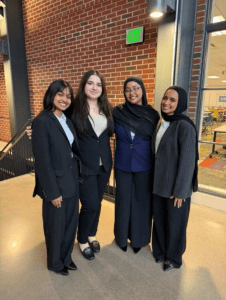
4 people standing together in workwear smiling

(Left to right: Nithila Amsaveni Balasubramanian, Marianna Merem, Mehrin Jahan, Momina Rehan)

The first-place team, Mehrin Jahan (computer science, business minor), Marianna Merem (mechanical engineering), Nithila Amsaveni Balasubramanian (computer science) and Momina Rehan (supply chain management), earned $1,200 and reflected on the competition as an introspective experience, sharing their game plan.

“My team first decided how we wanted to approach the situation that was presented,” said Jahan. “Momina led the major business portions. Marianna focused on coordination with NASA and execution. Nithila and I conducted in-depth research on AI and how it works. I even developed an AI system that implemented our suggested solution into our presentation.  

From start to finish, the project was highly collaborative, with each member leveraging their strengths while deepening their understanding of ethics.

“I had never researched how AI management works before this competition,” Jahan continued. “I also didn’t know AI was being used as a therapist. It opened my eyes to how important ethical oversight is in technology and how it can influence human autonomy.” 

Winning carried additional meaning. Her team was the only all-women team in the competition.  

“It proved that if you work hard and go above and beyond, you will succeed. It also showed what women can accomplish in professional environments,” Jahan said. “And honestly, presenting together was fun. My teammates did a fantastic job.” 

Across entrepreneurship, historical accountability, AI, and student leadership, 2026 Ethics Weeks showed that ethics is a continuous commitment in boardrooms, coding, classrooms, and competition.  

For Spartans, it reinforced that leadership is also defined by the courage to act responsibly in moments that matter the most.  

For more information on Ethics Week, visit their webpage.

Media Contact:

In Other News:

Top 20 graduate programs, full-time mba among public programs
Broad College graduate programs are designed to deliver a rigorous, experiential education
#1 among U.S. public institutions for sector diversity
Sector diversity reflects the industries MBA students come from, enriching classroom perspectives and collaboration.