


The School of Hospitality Business within the Broad College of Business is expanding its global engagement through a partnership with the African Studies Center and the Alliance for African Partnership (AAP), strengthening the university’s long-standing commitment to Africa while preparing students for leadership in the global hospitality industry.
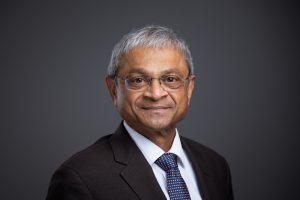
Karthik Namasivayam, director of The School of Hospitality Business
As director of The School of Hospitality Business, Karthik Namasivayam works with faculty and staff to shape curriculum that reflects emerging industry trends and essential professional competencies. One of the most critical of these competencies, he explained, is developing a global mindset. It’s a value shared across MSU, the Broad College of Business, and international initiatives such as AAP and the African Studies Center.
“The hospitality industry is inherently global,” he said. “Our students need to understand different cultures, markets, and economic contexts to succeed as future leaders. Africa is one of the fastest-growing regions in the world, and this partnership gives students exposure to both the opportunities and the complexities of hospitality and tourism across the continent.”
“The hospitality industry is inherently global. Our students need to understand different cultures, markets, and economic contexts to succeed as future leaders." -Namasivayam
The collaboration brings together several MSU entities. The African Studies Center, housed within International Studies and Programs, supports research, teaching and outreach focused on Africa. AAP is a consortium connecting MSU with leading African universities and research institutions, building on more than 65 years of collaboration. Within Broad, the International Business Center prioritizes developing a global perspective through education abroad programs, international internships, and research initiatives. Dr. Ahmet Kirca, who leads the center, notes that Africa is an expanding and increasingly important destination for U.S. businesses and this partnership addresses this squarely.

Issac Kalumbu, assistant director of outreach, African Studies Center
For Isaac Kalumbu, the assistant director for outreach in the MSU African Studies Center, the partnership began as an opportunity to expand outreach in Southern Africa while addressing a critical gap in hospitality education. “We collaborated with Professor Namasivayam to initiate a Southern African conference on hospitality and tourism with the goal of improving pedagogy,” he explained. “The focus is on how faculty can teach more effectively, how curriculum can be strengthened, and how we can establish shared standards across the region. We wanted the curriculum to reflect what the business community actually needs. When students graduate, are they ready for the job market? Are employers satisfied with the training the students receive?”
Namasivayam also emphasized that these efforts are especially important as countries within the Southern African Development Community (SADC) shift toward more diversified economies that include tourism and service industries.
“As these economies evolve, the demand for skilled hospitality leaders and research-informed policy continues to grow,” he said. “By engaging with institutions and industry leaders across the region, MSU is helping elevate hospitality education as a driver of economic development.”
One of the most visible outcomes of the partnership is the Hospitality and Tourism Education Conference in the Southern African Development Community (SADC) region, launched in 2024. According to Kalumbu, the conference was designed to address a fundamental question: how can hospitality and tourism education better serve the needs of the region?
“We brought together universities, industry leaders, student panels, and policymakers to discuss curriculum, teaching, and the delivery of hospitality education,” he said. “The goal is to improve these subjects are taught and ensure that what students learn aligns with the realities of the job market.”
The 2024 inaugural conference was held in Zimbabwe, followed by Botswana in 2025 and Malawi in 2026. Through these convenings, discussions have ranged from integrating artificial intelligence into hospitality education to strengthening gastronomy tourism and incorporating student perspectives on workforce challenges.
“We also want to establish shared standards across the region,” Kalumbu added. “At the same time, we’re encouraging student and faculty mobility, so that learning and research can happen across borders.”
Beyond discussion, the partnership is already producing tangible outcomes. Research initiatives, including a grant focused on youth entrepreneurship in Botswana’s hospitality sector, are underway, with additional projects in development. Plans are also being explored for an academic journal dedicated to hospitality and tourism in the region.
Kalumbu highlighted that long-term success depends on expanding opportunities for students and faculty across borders. “I would like to see more student mobility within the region,” he said. “Students in one country should have opportunities to learn from others. That exposure is what allows them to think creatively, build partnerships, and develop business models that reflect the full potential of the region.”
“Students in one country should have opportunities to learn from others. That exposure is what allows them to think creatively, build partnerships, and develop business models that reflect the full potential of the region.”-Kalumbu
He also emphasized the importance of funding to support these initiatives, particularly in lower- income communities where access to international experiences may be limited. “Grants are essential,” Kalumbu said. “Not just for research, but for programming that allows students to travel, collaborate, and gain meaningful experience.”
Looking ahead, the partnership is expected to continue expanding both geographically and academically. Participation has already grown from a handful of countries to a broader regional network, with interest from additional nations and potential for future global collaborations. Through research, conferences, and cross-continental engagement, the initiative aims to strengthen hospitality and tourism education while creating new pathways for students, faculty, and industry leaders to collaborate on a global scale.
In Other News:
24-week online course aims to equip professionals with global supply chain, logistics and procurement expertise
Applications are now open for the program’s inaugural cohort, beginning in fall 2026.
Broad College graduate programs are designed to deliver a rigorous, experiential education
Get Connected with Broad:
- Business College Complex
- 632 Bogue St
- East Lansing, MI 48824