- Kelly Ulrich
- Communications Manager II
- ulrichk1@msu.edu
- (517)-353-7123


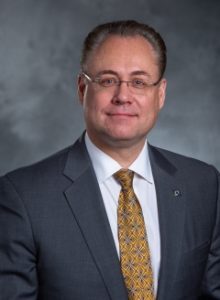
G. Tomas M. Hult, professor in the Department of Marketing at the Broad College of Business, has been recognized in the “2025 Highly Cited Researchers” list, a ranking organized annually by Clarivate Analytics.
Tomas M. Hult, professor in the Department of Marketing at the Broad College of Business, has been recognized in the “2025 Highly Cited Researchers” list, a ranking organized annually by Clarivate Analytics.
The international list recognizes research scientists from across the globe who have offered expertise and significantly influenced their respective fields of research. The list is created from highly cited papers that rank in the top 1% of citations for field and publication year in Clarivate’s Web of Science citation index.
Hult is a globally recognized thought leader in international marketing, marketing strategy, customer satisfaction, supply chain management, and international business, garnering more than 170,000 citations on Google Scholar. He is among the world’s top-cited business scholars and is consistently ranked in the top 10 globally in marketing by the Stanford University ranking.
This is the third time he has been included in Clarivate’s list of highly cited researchers, having been previously recognized in 2021 and 2022 in the category of “business and economics.”
Hult shared his thoughts on being named to this globally prestigious list, the impact of his research, and offered insights into how his work continues to shape the field.
You’ve been named among the top researchers globally in “economics and business,” one of the top 81 scholars in the world in that category, and one of only 7 in marketing. What does this recognition mean to you, both personally and in terms of the broader work happening at Broad College of Business at Michigan State University?
For me personally, it’s humbling and energizing. Humbling because so much of research is collaborative and incremental, and energizing because it reinforces the work we’re doing in international marketing, supply chains, customer satisfaction, and strategy matters, and has a global impact.
At Broad and MSU more broadly, I’d like to see this recognition reflect how we value global reach, rigorous scholarship, and real-world relevance. I hope it sends the message that we are not only engaged in world-class research but also educating future leaders who will apply these insights in business and society. For example, my last keynote was at Aramco in Saudi Arabia, and my next engagement is with the business community in Iceland. So, the Broad College and my work have an appreciative reach globally, beyond being heavily cited by other academics.
Your research spans international marketing strategy, supply chain management, and customer satisfaction, among others, areas that seem quite distinct at first glance. How do you see these areas connecting, and why is this multidisciplinary approach important now?
They may appear distinct, but I view them as deeply interconnected. In today’s global economy, a firm’s marketing strategy cannot be separated from its supply-chain decisions or its ability to satisfy and retain customers.
For example, a robust supply chain enables consistent delivery and customer satisfaction; strong international marketing strategy shapes brand positioning and global value creation; and customer satisfaction becomes a strategic company asset that links back to strategy and operations.
The multidisciplinary approach is critical now because business challenges are no longer siloed: global disruptions, digital platforms, fast-changing customer expectations force firms to integrate across domains. My work tries to bridge these areas to provide companies with strategic solutions that they can act on.
In light of your global recognition and research insights, what are the most pressing challenges you see for businesses operating in an international environment, and what should they focus on to maintain competitive advantage?
Three interlinked challenges stand out.
One: Volatile global supply chains and rising expectations for speed, transparency, and sustainability. A healthy global marketplace is signified by constructive competition among producers and customers, where company revenue is driven by the value produced and customer satisfaction received.
Two: Evolving customer expectations in a hyper-connected world – “the reign of the customer” as we’ve titled it for one of our books – which means firms must rethink customer experiences and the customer journey as strategic and customers being viewed as strategic company assets.
Three: The complex international business ecosystem (trade, regulation, culture) that demands more agility and ecosystem thinking. This ecosystem is a dynamic, constantly changing cogwheel-like system in which different MNCs interact, compete, engage, and collaborate over time.
To maintain competitive advantage, businesses should focus on (a) orchestration of capabilities across marketing, operations and strategy, which we wrote about in a recent article; (b) building customer-centric architectures where customers are treated as strategic assets; and (c) developing dynamic capabilities to sense, seize and transform in global contexts.
Given your role as educator and researcher, how do you translate your scholarly work into teaching and mentoring the next generation of business leaders, and what do you hope they take away?
I believe strongly in the translational bridge between scholarship and practice. In the classroom (especially Executive MBA and undergraduate teaching), I bring in real-world cases, global strategy simulations, Nobel prize-winning ideas (game theory, etc.), and research-based insights so students can learn, debate, and apply them.
Two of the sessions in my current EMBA class are directly related to two of the keynote presentations I’ve been giving around the world. The session in Iceland in a couple of weeks is basically the first session in the EMBA course – based on $100 million of research on the customer journey over 30 years at the American Customer Satisfaction Index, where I serve as a business executive and researcher.
I also mentor Ph.D. students, encourage publication in leading journals, and seek to instill rigorous thinking and a global mindset. What I hope they take away is that business leadership today is about more than functional competence; it’s about integrative thinking, global awareness, continuous learning, and the ability to lead change in complex environments.
Participants in one of my courses are encouraged to know relevant frameworks and also be able to apply and adapt them. I stress heavily in my courses that my goal is to develop a “toolkit” that they can go back to when needed in their career.
Perhaps interestingly, as a citizen of Sweden (dual citizen with the United States), I have connected every aspect of the EMBA course on “International Strategies” to Nobel Prize-winning works so that the participants get a unique foundation of my work and of time-tested Nobel Prize-winning works throughout the discussion.
Looking ahead, what are you excited about in your research agenda, and how do you hope your work will make a difference in academia, business practice, and society?
I’m excited about a number of lines of my current inquiry. For instance, integrating sustainability and circular economy thinking into international business, from a recent article in the Journal of International Business Studies that we had published in 2025; examining how digital platforms and ecosystems reshape marketing and supply-chain strategy; refining our understanding of customer asset management in global firms; and continuing to push methodological rigor (e.g., partial least squares structural equation modeling, which relates to our top-cited book on PLS) so that our findings are robust and actionable.
I hope my work will make a difference by (a) advancing academic theory in ways that matter to scholars and practitioners; (b) informing business practice so that executives and managers have better evidence-based cause-and-effect tools; and (c) contributing to broader society by helping firms operate more responsibly, sustainably and effectively in the global economy.
Ultimately, my goal is to help shape a future where sustainability, international strategy, marketing rigor, and customer satisfaction are not separate conversations but a unified framework for how companies create value and compete responsibly.
Media Contact:
In Other News:

Kenneth Bills is an associate professor of accounting and information systems
Audio
New research from Broad explores how state law impacts medical care in hospital
Broad research finds political polarization in financial news can shape investor interpretation and increase trading
Get Connected with Broad:
- Business College Complex
- 632 Bogue St
- East Lansing, MI 48824