- Kelly Ulrich
- Communications Manager II
- ulrichk1@msu.edu
- (517)-353-7123


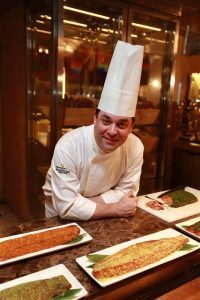
Roy is the only educator in his cohort, a distinction that highlights both his professional background and the growing visibility of MSU in food and beverage innovation.
Adam Roy, the Dr. Lewis J. & Mrs. Ruth E. Minor Chef-Professor of Culinary Business at the Broad College of Business, has been selected to participate in the Culinary Enrichment and Innovation Program (CEIP), a highly selective executive education experience administered by the Culinary Institute of America (CIA) and supported by Hormel Foods.
Since 2008, CEIP has brought together corporate chefs, hospitality leaders, university chefs, and food service innovators for a multi-module experience focused on leadership, product development, and emerging industry trends. Participants engage in classroom learning, collaborative kitchen work, site visits, and industry projects. Each cohort receives hundreds of applications, and only 20 chefs are selected. Roy is the only educator in his cohort, a distinction that highlights both his professional background and the growing visibility of MSU in food and beverage innovation.
A national network of industry leaders
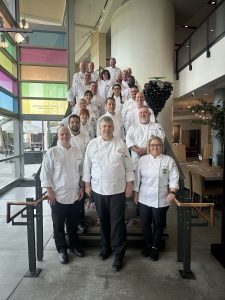
CEIP is designed to connect professionals across the food industry while exposing participants to new ideas, techniques, and strategic approaches.
CEIP is designed to connect professionals across the food industry while exposing participants to new ideas, techniques, and strategic approaches. Roy has completed modules in Napa, California, and San Antonio, Texas, with a final session at the famous CIA’s Hyde Park, New York campus scheduled for April.
Each module focuses on a different theme. In Napa, participants explored global flavors, product development, and ethical responsibility while working in teams to develop new culinary concepts. In San Antonio, the program shifted toward health, wellness, and longevity research, examining how food, culture, and environment influence long-term wellbeing and how those insights can inform menu innovation.
The final New York campus module, will center on leadership and innovation, including industry case studies, collaboration with leading chefs, and discussions around future food trends.
Bringing an educator’s perspective
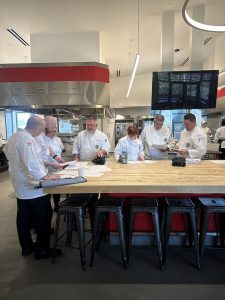
Roy contributes a distinct viewpoint shaped by his role as an educator and his extensive international culinary career. “I bring an educator’s point of view and my international experience,” he said. “I lived and worked internationally for almost 20 years, and I’m able to bring my global cuisine and global flavor exposure to my fellow participants.”
The diversity of participants’ industry backgrounds in the program creates space for them to exchange ideas and approach challenges from multiple perspectives.
“It’s a great group of professionals,” Roy said. “We have corporate chefs at big-name hotel brands, catering chefs, private club chefs, hospital chefs, senior living chefs, chefs from K-12 food service programs who are doing amazing things, we have a fellow chef in San Francisco who is working in elder care facilities and doing really innovative things with their food programs. Everybody has their own specialty, and it’s fun to bounce ideas off each other.”
Roy contributes a distinct viewpoint shaped by his role as an educator and his extensive international culinary career.
“I bring an educator’s point of view and my international experience,” he said. “I lived and worked internationally for almost 20 years, and I’m able to bring my global cuisine and global flavor exposure to my fellow participants.”
For Roy, participation in CEIP is closely connected to his work at MSU. The program provides exposure to emerging techniques, product development strategies, and industry conversations that can be integrated directly into coursework.
“It helps bring a little spotlight on MSU to say there’s a professional chef in our program… we are doing things with innovation and trying to inject new concepts into our classroom,” he said.
Insights from the program are already shaping classroom discussions around global cuisine, health-focused menu design, product innovation, and corporate social responsibility. Roy is also exploring menu development approaches, including advanced food safety management practices, that reflect evolving industry standards.
Preparing students for the future of hospitality
Roy sees the greatest impact of the experience in how it benefits MSU students. His exposure to industry networks and real-world innovation helps ensure that learning remains relevant as hospitality careers continue to evolve.
He emphasizes that food and beverage education builds skills that extend beyond culinary technique, including leadership, strategic thinking, and entrepreneurship.
“Food and beverage education gives students a foundation that helps them solve problems, lead teams, and succeed in many different careers,” Roy said. “They often think they won’t go into food and beverage, they’ll say they’re going into real estate or finance, but a few months after graduation, I get a call saying they’re working in a restaurant. It’s a step in the door that does nothing but good things for their future. Food and beverage helps you solve problems, it challenges you, and it builds skills that carry into any career.”
As Roy prepares for the program’s final module this spring, he looks forward to continuing collaboration with industry leaders and bringing new ideas back to campus. Through opportunities like CEIP, faculty engagement with industry innovation strengthens the student experience and reinforces the Broad College’s commitment to experiential learning and forward-looking hospitality education.
Media Contact:
In Other News:

Charles A. Gliozzo International Award for Public Diplomacy

MSU Award for Outstanding Service to Education Abroad

Helen Dashney is the namesake faculty advisor for the Dashney Women’s Leadership Accelerator (DWLA)
Get Connected with Broad:
- Business College Complex
- 632 Bogue St
- East Lansing, MI 48824